


Forms and Fees Subject to Change July 1
CURRENT FEE SCHEDULEFEMA's Preliminary Flood Insurance Rate Maps
VIEW HEREThe County's Draft Phase 3 Chesapeake Bay Action Plan has been submitted to DEQ for review. Submit public comments to [email protected].
View Here

Forms and Fees Subject to Change July 1CURRENT FEE SCHEDULE
FEMA's Preliminary Flood Insurance Rate MapsVIEW HERE
The County's Draft Phase 3 Chesapeake Bay Action Plan has been submitted to DEQ for review. Submit public comments to [email protected]. View Here
Endangered Status of the Northern Long-eared Bat: What Developers and Landowners Need to Know
The Northern Long-eared Bat (NLEB) was officially listed as a federally endangered species on March 31, 2023. This change increases protection for the species and has important implications for forestry, development, and land management activities in Virginia, including here in Prince William County.
Why the Bat Is Endangered
NLEBs overwinter in caves and spend summers in forests, with a year-round population present in Southeast Virginia. Populations have collapsed due to White-nose Syndrome, a fungus that grows in caves and harms hibernating bats. Because of this severe decline, NLEBs were reclassified from Threatened (2015) to Endangered (2023).
As an endangered species, any harm to NLEBs or their habitat is prohibited, including tree clearing or land disturbance in areas where they live or roost.
What Developers and Landowners Need to Know
Carrying out typical forest management or development activities without proper review could violate the Endangered Species Act. The U.S. Fish and Wildlife Service (USFWS) provides guidance to help project proponents understand whether their projects may affect NLEBs or other protected bat species, such as the Tri-colored Bat (TCB) and Little Brown Bat (LBB).
Tools and Resources Available
- Threatened and Endangered Bats Consultation Tool – helps evaluate potential impacts of a project on NLEB, TCB, and LBB.
- USFWS NLEB Rangewide Decision Key (DKey) – determines if a project will affect NLEBs and outlines next steps.
Regulatory Buffers Around Known Bat Sites
- NLEB hibernacula: 0.25 mile inner buffer and 5.0 mile outer buffer
- TCB and LBB hibernacula: 0.25 mile inner buffer and 3.0 mile outer buffer
- NLEB, TCB, and LBB roosts: 150 ft buffer
- NLEB and TCB captures (mist-net/auditory): 1.5 mile buffer
- NLEB and TCB consultation range: Data downloaded from USFWS’s ECOS website that depicts the areas in Virginia where consultation for these species is necessary under state and federal endangered species acts.
- NLEB and TCB year-round Zone 1: Depicts areas in Virginia where these bats are living year-round.
Federal vs. Non-Federal Projects
- Projects that have a federal connection (nexus) must be submitted to USFWS through their online project review tool. Coordination with the appropriate federal agency that is authorizing, funding, or carrying out the proposed activity may also be necessary.
- Projects without a federal nexus should still use the project review tool to determine whether your project site is located within a regulatory buffer and/or consultation range for any of these listed bats. If so, coordination with the Environmental Services Section of Virginia Department of Wildlife Resources (DWR ESS) is necessary.
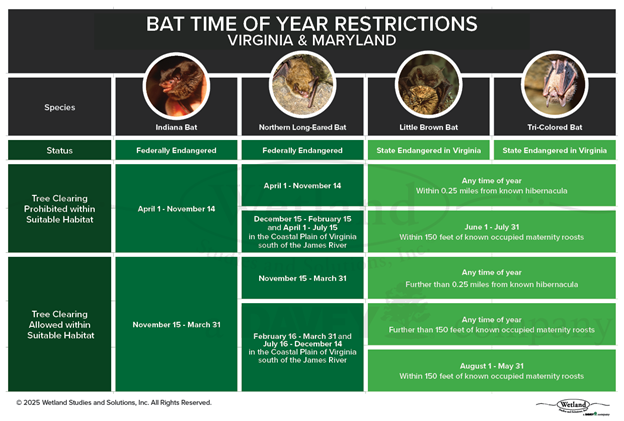
Time-of-Year Restrictions
Projects with a ‘May Affect’ or ‘Likely to Adversely Affect’ determination are subject to time-of-year restrictions that prohibit tree clearing from April 1 through November 14, unless further consultation is conducted with the U.S. Fish and Wildlife Service (USFWS) or the U.S. Army Corps of Engineers (COE), as applicable.
Projects that had federal wetland permits issued before March 31, 2023, but have not yet cleared trees, must re-coordinate with the Army Corps of Engineers.
Next Steps
Before starting tree clearing or land development, project proponents should:
- Complete the USFWS Decision Key (DKey).
- Use the consultation and mapping tools to determine if their site falls within a regulated area.
- Coordinate with USFWS, the Army Corps of Engineers, or DWR as needed.
For assistance, you may also contact a qualified environmental consultant to help with review and coordination.
Latest Press Releases


