


Forms and Fees Subject to Change July 1
CURRENT FEE SCHEDULEFEMA's Preliminary Flood Insurance Rate Maps
VIEW HEREThe County's Draft Phase 3 Chesapeake Bay Action Plan has been submitted to DEQ for review. Submit public comments to [email protected].
View Here

Forms and Fees Subject to Change July 1CURRENT FEE SCHEDULE
FEMA's Preliminary Flood Insurance Rate MapsVIEW HERE
The County's Draft Phase 3 Chesapeake Bay Action Plan has been submitted to DEQ for review. Submit public comments to [email protected]. View Here
Critically Imperiled Plant Conservation – Virginia Fanpetals Planted at County Restoration Sites
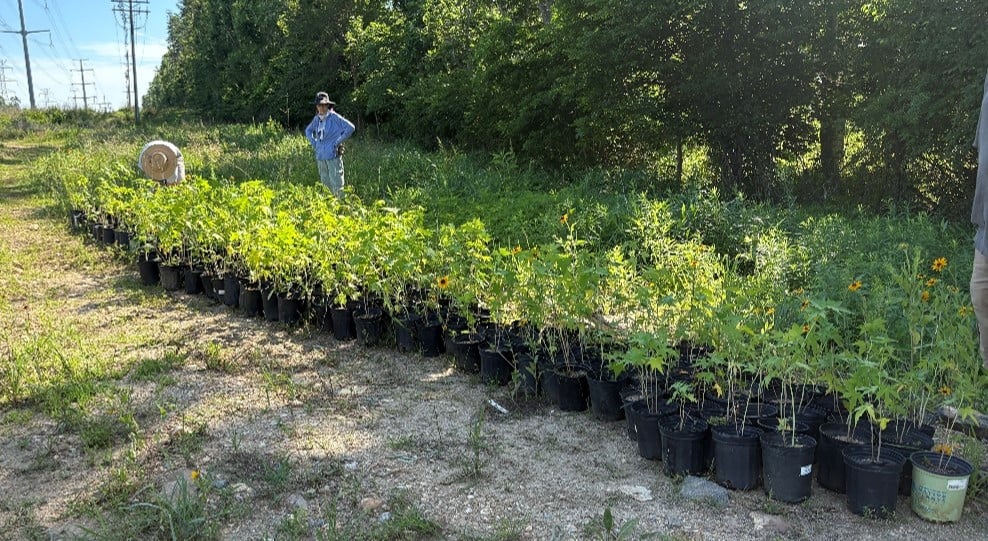
Virginia fanpetals are herbaceous perennials in the mallow family that grow up to 15 ft tall and produce small, white flowers. They prefer sandy or rocky stream banks in full sun and tolerate poor soil, having even been found in lowland roadside ditches.[1]
However, habitat loss and invasive species threaten their populations. In Virginia, Maryland, Indiana, and Ontario, fanpetals are listed as critically imperiled. They are listed as imperiled in Pennsylvania, West Virginia, and Kentucky; vulnerable in Ohio; and possibly extirpated from Tennessee.[2] County staff hope that the plantings from this conservation project will mature into stable, long-term populations of fanpetals in Prince William County.
If successful, the fanpetals will be a promising method to create shade on restoration sites soon after construction, due to how quickly the plants grow. Shade is important for streams because it cools stream water, leading to increased dissolved oxygen levels, regulated algae growth, and better habitat for aquatic species that prefer lower temperatures.
Many stream restoration projects require that trees are removed to make way for construction equipment, bank stabilization structures, or floodplain reconnection, which can expose parts of the stream to more sunlight. Native tree saplings are replanted after construction completes in order to regrow a canopy, but woody species take time to grow tall enough and replace what was removed. Woody saplings may also be impacted by deer browsing behavior, beaver activity, and high velocity stormwater. Because of this, shade can be difficult to create on new projects before the reforested canopy has had time to grow, especially without the use of equipment like artificial covers that require ongoing maintenance.
Since fanpetals germinate well, grow tall quickly, and tolerate sunny, disturbed stream valleys, they are a promising way to provide shade on establishing restoration sites where clearing and reforesting were necessary. If the fanpetals prove to be a good source of early shade, this strategy may open the door for additional conservation efforts moving forward.
Public Works is looking forward to seeing the success and growth of the fanpetals. County staff have already noticed seedlings sprout new leaves and begin to flower, as seen in the photos below. Environmental Management extends their gratitude to all volunteers who assisted with the planting effort.
 |
 |
||
[2] https://explorer.natureserve.org/Taxon/ELEMENT_GLOBAL.2.155128/Ripariosida_hermaphrodita
Latest Press Releases


